
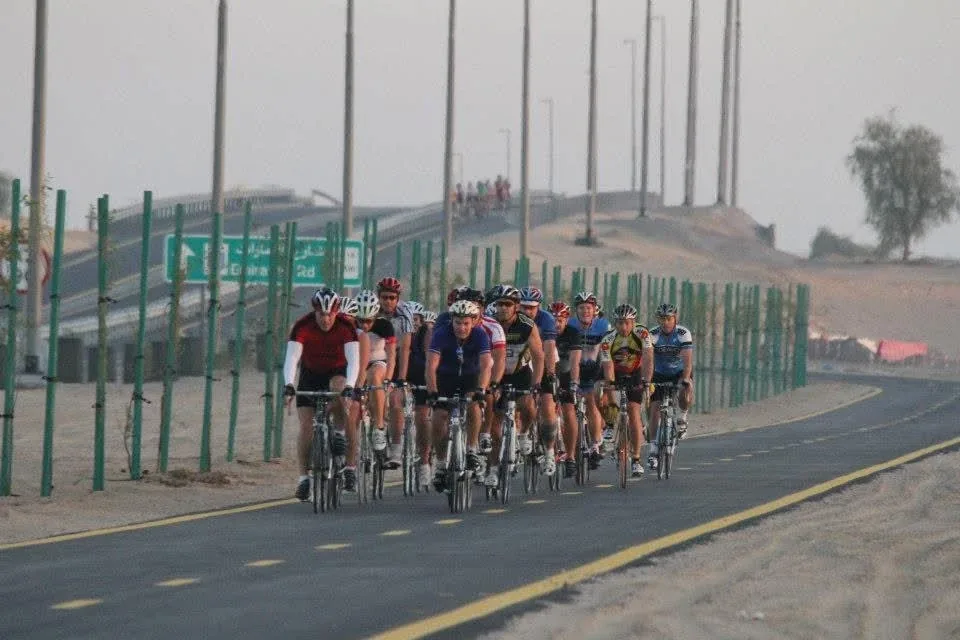
Al Qudra Cycling Track.
Entrances, routes, facilities, water, hazards and joining CSD at Al Qudra.
E01Where exactly is Al Qudra Cycle Track, and which entrance should I use?
CSD meets at the Bottom of the Stick (BOTS) gazebo, not the Last Exit area at the Top of the Stick (TOTS). Use the CSD map link in the ride card rather than searching only for 'Al Qudra Cycle Track', because mapping apps may route visitors to a different access point. Riders should confirm the live start location before departure.
CSD meets at the BOTS gazebo. Use the map button on the current ride page because a generic Al Qudra search may send a visitor to TOTS or another access point.
E02What are the Al Qudra route options, loop distances and turnaround points?
Al Qudra is a connected network rather than one fixed lap. Common formats include the Stick out-and-back, the main loop, shorter loop or bypass combinations, and CSD routes of roughly 35, 65, 85 and 104 km. Published totals vary because sources measure different segments and extensions.
CSD combines the network into attendance-dependent rides of roughly 35, 65, 85 and 104 km. Use CSD’s published route maps or GPX files for named turns and regroup points rather than assuming a loop total from another source.
E03Is Al Qudra Cycle Track free, and does it have opening hours?
Official visitor information promotes public access to Al Qudra but does not provide a single staffed opening-hour guarantee for every part of the network. The riding track is generally used without an entry fee, while rentals, cafes and other services have their own hours. Closures, works or event controls can still apply.
The track is normally free and accessible without a staffed entry gate, but events, works or temporary controls can still affect access.
E04Is the track lit for pre-dawn or night riding?
Do not assume the whole Al Qudra network is lit. CSD’s current field knowledge is that the Stick has secondary lighting while the main loops are unlit. Riders starting before dawn or finishing after dark need effective front and rear lights, reflective details and enough battery for the whole ride. Lighting coverage can change, so check current conditions before setting out.
CSD treats front and rear lights as essential whenever a ride begins before full daylight.
E05Where should I park or ask a taxi to drop me?
Use the exact BOTS or TOTS pin when arranging parking or a taxi. BOTS can fill early during peak summer riding, while TOTS has a different access pattern and is not CSD's normal ride start. Allow time to unload safely without obstructing riders and confirm the return pickup point before setting out.
BOTS can fill very early in summer; TOTS is a different start area and is not CSD's normal meeting point. Use the exact pin and allow time to unload without blocking the track.
E06Can I rent a road bike at Al Qudra, and should I book ahead?
Road-bike rental is available in Dubai and should be booked ahead, especially for a particular size, pedal system or weekend delivery. Revolution Cycles currently offers advance road-bike booking and can confirm whether delivery to CSD is available. Separate onsite Al Qudra operators may have different bicycles, terms and hours.
Visitors riding with CSD can ask Revolution Cycles about advance rental and possible delivery to the ride start. Onsite operators have separate stock, terms and opening hours.
E07What ID, deposit, pedals and accessories do rentals require or provide?
Revolution Cycles currently states that its road-bike rental includes a helmet, saddle bag and pedals and requires a refundable AED500 cash deposit. Requirements vary by operator and booking, so obtain written confirmation of the accepted ID, pedal type, tools, damage liability, cancellation and return conditions.
Ask for written confirmation of the exact bike, pedal system, helmet, repair kit, ID, deposit and damage terms.
E08Are toilets, showers, lockers, cafes and changing facilities available?
RTA and tourism sources describe toilets, rest areas, restaurants and rental services across the network, but showers, lockers, changing areas and opening times can vary by access point.
BOTS and TOTS provide the main clusters of facilities. Check current opening times before travelling and do not make essential luggage or post-ride plans dependent on an unverified service.
E09Is there water or food anywhere on the route?
Plan the main loops as self-supported. Food and water are concentrated near established access points; riders should not expect a reliable refill on a remote loop. Start with sufficient fluid, food and an emergency margin, and turn back before supplies become tight. Opening hours at cafes and kiosks must be checked separately.
CSD treats the remote loops as self-supported. The mosque, Bab Al Shams, Al Jiyad Stables and the Stick petrol-station area can be useful reference points, but a rider must not depend on any stop without a current access and opening-hours check.
E10How much water and nutrition should I carry for each loop?
The amount to carry depends on ride time, heat, humidity, intensity and personal sweat loss, so a fixed bottle count is unsafe. Estimate the time between reliable refills, use a tested fluid and carbohydrate plan and carry a margin. Water may be enough for a shorter easy ride; prolonged hot rides may require carbohydrate and sodium according to individual need.
Plan by time between confirmed refills rather than by loop name. A 50 km loop can take two hours at 25 km/h before wind, heat or stops are added, so visitors should carry a margin and use an individual drinking and fuelling plan.
E11Is Al Qudra suitable for beginners, families and solo riders?
Short out-and-back sections can suit beginners and families who remain within their control and water limits. The long desert loops are exposed and can leave a rider far from the start, so distance, navigation, daylight, heat and repair ability matter. Solo riders need a clear route and check-in plan; first-time visitors should consider a suitable group.
For families or new riders, the Stick offers easier turnaround options and facilities at either end. The long loops are not beginner routes merely because the surface is smooth.
E12What hazards should I expect: heat, wind, sand, darkness or wildlife?
Key hazards are heat and humidity, headwind or crosswind, sand on the surface, darkness, fatigue and occasional wildlife. Check NCM forecasts and warnings, use lights before dawn, reduce speed where sand or animals are present and do not approach or feed wildlife. Wind can make the return substantially harder than the outward leg.
Wildlife is part of the Al Qudra experience, but sightings are not guaranteed. Slow down, hold a predictable line and never approach or feed an animal.
E13What should I do after a puncture, crash or mechanical failure?
Move out of the riding line, warn approaching riders and first assess people before equipment. For a routine puncture, use the carried repair kit. For a serious crash, head impact, suspected heat illness or inability to continue safely, call for appropriate help; in a UAE emergency call 998. Share an exact pin or emergency-phone location and do not move a seriously injured rider unless immediate danger requires it.
During a CSD ride, the support vehicle can assist with safety and an unrepairable mechanical; on any private ride, the rider still needs an independent recovery plan.
E14What pace and distance do CSD's Saturday and Sunday rides follow?
Saturday groups are created from attendance and typically target averages from about 25 km/h to 34+ km/h over roughly 35-104 km. Sunday is the Legendary Coffee Ride to Al Jiyad Stables, about 60 km return, normally using several target-average groups. Rides usually operate no-drop with controlled points, while the 85 km Saturday route may regroup after a faster section near the mosque.
Use the live Saturday and Sunday ride cards for the current start time, target averages and attendance-dependent distances. The 85 km Saturday route may regroup at the mosque for a mid-ride water stop.
E15How do I join CSD at Al Qudra, and what happens if I cannot hold the group pace?
First-time riders should message CSD on WhatsApp (+971 50 273 2453), review the current ride card and arrive early at BOTS. Choose a group whose target average and distance you can sustain. CSD normally applies a no-drop approach, but riders remain responsible for a suitable bicycle, equipment, food, water and honest pace choice. The support vehicle is not a taxi.
Message CSD through the general WhatsApp button, arrive before the briefing and be honest about pace. Groups are self-managed after departure, so communicate early if the speed or distance is not right.
Information and external links were reviewed on 21 October 2026 and were accurate to the best of CSD's knowledge at the time of writing. Medical, training and nutrition content is general education, not personal advice. Guidance, facilities, schedules, prices and product information can change, so check the linked source and current local advice before acting.