
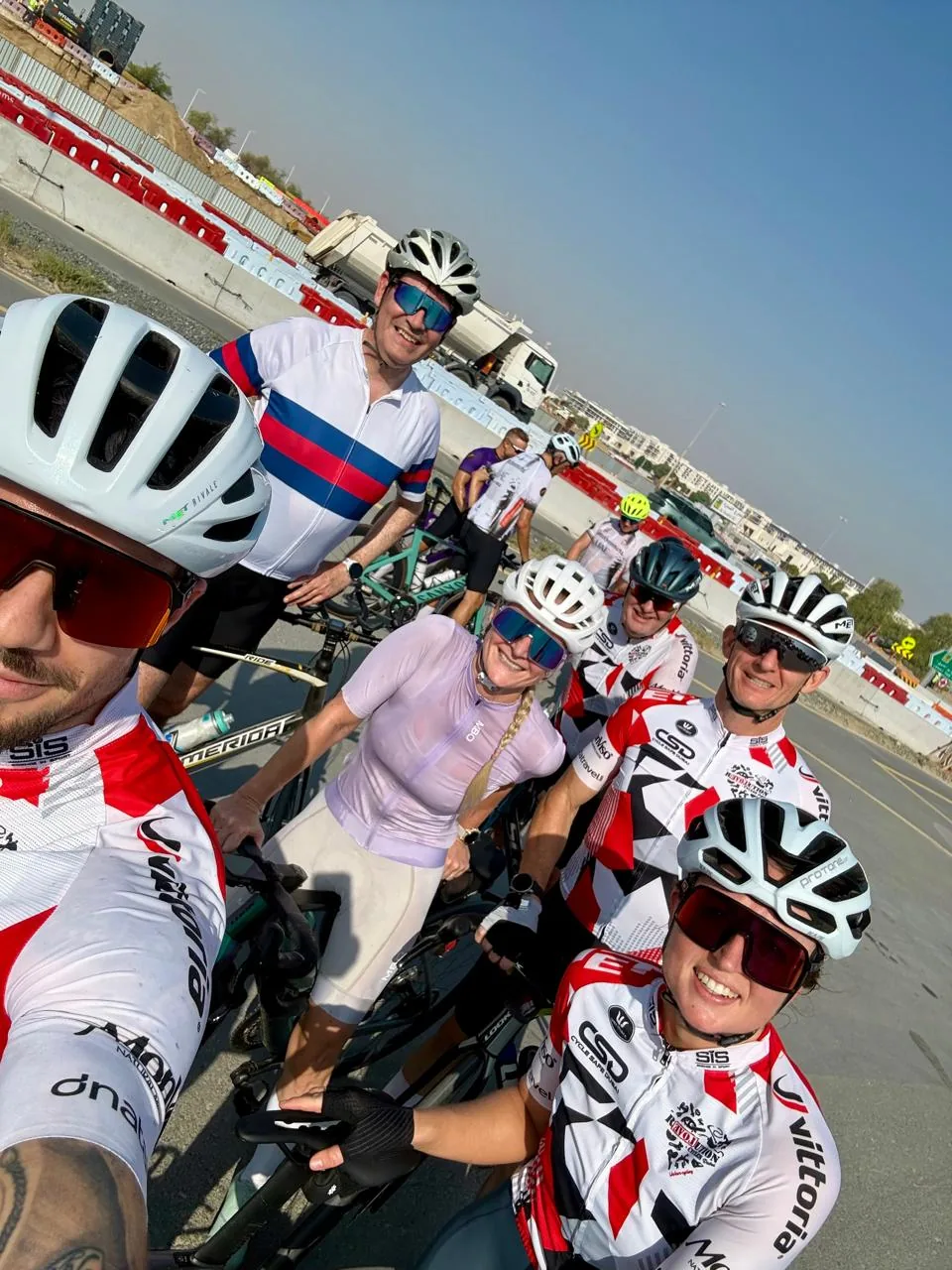
Cycling in Dubai and the UAE.
Tracks, laws, seasons, safety, events and finding the right local ride.
A01Where are the best places to cycle in Dubai?
Dubai's strongest road-cycling destinations are Al Qudra for long desert endurance riding, Nad Al Sheba and Meydan for shorter controlled loops, and the city's canal, marina and Jumeirah tracks for urban leisure riding. Mushrif and Hatta are better suited to mountain biking, so the best choice depends on bike type, distance, experience and whether the rider wants a training track or sightseeing route.
For CSD riders, Al Qudra is the main traffic-light-free road-cycling base, with more than 135 km available across the connected network and growing connections. Urban paths can be busy with walkers, runners, dogs and leisure riders, so they are not interchangeable with a training track.
A02Which Dubai cycling tracks are best for road bikes, mountain bikes and beginners?
Al Qudra, Nad Al Sheba and Meydan are established paved choices for road bikes; Hatta and Mushrif provide off-road or mountain-bike terrain. Beginners usually benefit from shorter, controlled loops such as Nad Al Sheba before progressing to long, exposed desert distances, but they should still check track rules and current conditions.
For a first road ride, choose a short, low-traffic section and build control before distance. CSD rides use road bikes on paved tracks; Hatta and Mushrif serve different off-road needs.
A03Is cycling safe in Dubai and the UAE?
Dubai has extensive purpose-built cycling infrastructure, including external training tracks and urban paths, which can reduce exposure to motor traffic when used correctly. Safety still depends on using the designated facility, obeying signs and speed limits, wearing appropriate equipment, checking weather and visibility, and understanding that public-road and mountain routes have different risks.
CSD recommends purpose-built tracks rather than public roads wherever possible. A dedicated track reduces exposure to motor traffic but does not remove risk from speed, heat, wind, sand, other users or poor bike control. It is also illegal to ride on certain road types.
A04What are the cycling laws and helmet rules in Dubai?
RTA instructs riders to use designated tracks where available, ride with traffic, dismount at pedestrian crossings, avoid dual headsets/earphones and wear a helmet (and reflective jacket). Dubai rules also prohibit cycling on roads with speed limits above 60km/h and set different speed limits for urban, amateur and shared tracks, while external training tracks such as Al Qudra remain subject to safety instructions rather than a stated cycling speed cap.
Use the current RTA guidance as the rule source and check it again before riding or travelling, because legal wording can change. A route appearing in an app does not make it permitted.
A05Can cyclists ride on public roads in Dubai, and which roads are prohibited?
Cyclists must use designated tracks where provided and may not ride on roads whose speed limit exceeds 60km/h. On any permitted shared-road section, riders must follow traffic direction, signs and applicable speed/safety rules; route legality should be checked rather than assumed from a map or previous ride.
CSD does not publish an open-road route unless its current legality, traffic exposure and recovery plan have been checked.
A06Are Dubai cycling tracks free, lit and open at night?
Access, lighting and opening hours vary by location: Nad Al Sheba is promoted by Visit Dubai as free, open 24 hours and lit, while much of Al Qudra is not illuminated after dark. RTA also lists set opening hours for cycling tracks inside public parks, so visitors should check the specific venue rather than assume all tracks operate the same way.
CSD field knowledge is that the Al Qudra loops are largely unlit and the Stick has only partial or secondary lighting. Use effective front and rear lights whenever a ride begins before full daylight. Light should cover 'to be seen and the see'.
A07When is the best season and time of day to cycle in Dubai?
Visit Dubai identifies October through May as the most attractive period for outdoor cycling, with winter offering milder conditions than summer. Early morning is common for longer rides, but riders must still check temperature, humidity, wind, dust, sunrise and visibility for the exact day rather than relying only on the month.
From Saturday 21 November 2026, CSD’s Saturday and Sunday rides start at 06:30. Riders should arrive ready by 06:15 at BOTS. The next seasonal change will be announced in the current ride notice.
A08How do Dubai cyclists manage heat, humidity and strong desert winds?
Experienced riders manage pace and distance, start earlier, carry sufficient fluid and fuel, and change or cancel plans when temperature, humidity, wind, dust or air quality make the intended session unsafe. Visitors from cooler climates should build exposure gradually and follow individual medical advice, because hydration and heat tolerance vary substantially between riders.
CSD's practical rule is simple: shorten or cancel the ride before conditions become unsafe. Visitors from cooler climates should make their first UAE rides shorter and easier, and nobody should feel pressured to continue because a ride was planned.
A09Where can I rent a good road bike in Dubai?
Bicycle rental is available in the city and identifies track-side rental at Al Qudra, in the Marina, Kite Beach and other tourist attraction areas. Government tourism sites including dnatatravel support this while its broader guide points visitors to established retailers and rental services including long established bike shops. Performance-road-bike availability is size- and date-dependent, so visitors should reserve ahead and confirm frame size, pedals, helmet, deposit, collection time and breakdown support directly with the operator.
For a performance road bike, CSD's partner Revolution Cycles can confirm size, pedals, collection or delivery and support through the CSD contact route. Bike-share bicycles are a different product and are not suitable for CSD road-group speeds while they are availble around cycling locations including Al Qudra but offer no helmet rental so you'll need to bring one.
A10What should I carry on a Dubai ride?
At minimum, carry a helmet, charged phone, identification and emergency contact, sufficient water and ride fuel, lights/visibility equipment when relevant, and the tools and spares needed for a puncture. On remote desert or mountain rides, add more self-sufficiency and a clear recovery plan because shade, water, taxis and mechanical help may be limited.
CSD requires riders to arrive self-sufficient. The sponsored support vehicle assists with safety and ride incidents, but it is not a taxi and does not replace a charged phone, water, food, tools or a recovery plan.
A11How do I find a cycling group or club in Dubai?
Tourism guides suggest holiday visitors can join local groups and names Cycle Safe Dubai as a long established group being free to try. General records do not show all visitor true community-cycling history or the current suitability of any group. CSD offer you the opportunity to attented, but showing up on a morning at the major locations will get you a group.
Cycle Safe Dubai has organised structured weekend rides at Al Qudra since 2008 and welcomes suitable residents and visiting road cyclists. Message CSD first, read the current ride card and choose a group whose target average and distance you can sustain.
A12What speed and distance do Dubai group rides expect?
There is no single Dubai standard: published rides range from shorter social distances to fast, long experienced-rider sessions. Riders should use the organiser's stated target and minimum speed, distance, regroup/drop policy and required experience—not a generic label such as 'social'—to decide whether a ride is suitable.
CSD publishes target average speeds because Al Qudra has no traffic lights or routine road stops. Wind and small rises change the moment-to-moment speed, so riders communicate and check the group rather than treating the target as a constant number.
A13Are there beginner-friendly group rides in Dubai?
Yes, some Dubai organisers publish shorter or skills-oriented rides, and Visit Dubai points to a 36km beginner option among local offerings. 'Beginner-friendly' is not universal, so a new rider should confirm bike-handling expectations, minimum pace, total distance, drop policy and whether instruction or mechanical support is actually provided.
CSD's practical entry benchmark is normally the ability to ride about 25 km/h with confident braking, gearing, turning and line control. Contact CSD before the first ride so the team can suggest the most suitable starting group.
A14Where can I service or repair a bike near Dubai's main tracks?
Dubai has established workshops and retailers near major cycling areas, including Motor City and the Al Qudra corridor, but location alone does not guarantee same-day capacity or support for every brand. Visitors should book ahead and confirm opening hours, collection/delivery, parts availability and whether emergency or track-side assistance is offered.
Revolution Cycles in Motor City is CSD's partner workshop near the Al Qudra corridor. Book ahead for bike assembly, fitting, servicing or rental support; same-day capacity should never be assumed. If you're a visitor to Dubai (and UAE) they have a tourist option too.
A15What are the main cycling events in Dubai and the UAE?
Major current fixtures include Dubai Ride, the Spinneys Dubai 92 Cycle Challenge and its build-up rides, the UAE Tour, plus federation-listed triathlon and multisport events in Dubai and Abu Dhabi. Dates, routes and registration change each season.
The CSD Calendar brings together selected cycling and multisport events across the emirates, including Dubai Ride, the Spinneys Dubai 92 Cycle Challenge and build-up rides, the UAE Tour and UAE Tour Women.
Information and external links were reviewed on 21 October 2026 and were accurate to the best of CSD's knowledge at the time of writing. Medical, training and nutrition content is general education, not personal advice. Guidance, facilities, schedules, prices and product information can change, so check the linked source and current local advice before acting.